Top Posts & Pages
Recent Posts
My Book
Pro .NET Best Practices
Stephen Ritchie's offerings of ruthlessly helpful software engineering practices.
A very big thank you to AgileDC 2025 for hosting our presentation yesterday. Fadi Stephan and I gave a talk titled, “Back to the Future – A look back at Agile Engineering Practices and their Future with AI” offered our experience and perspective on a few important questions:
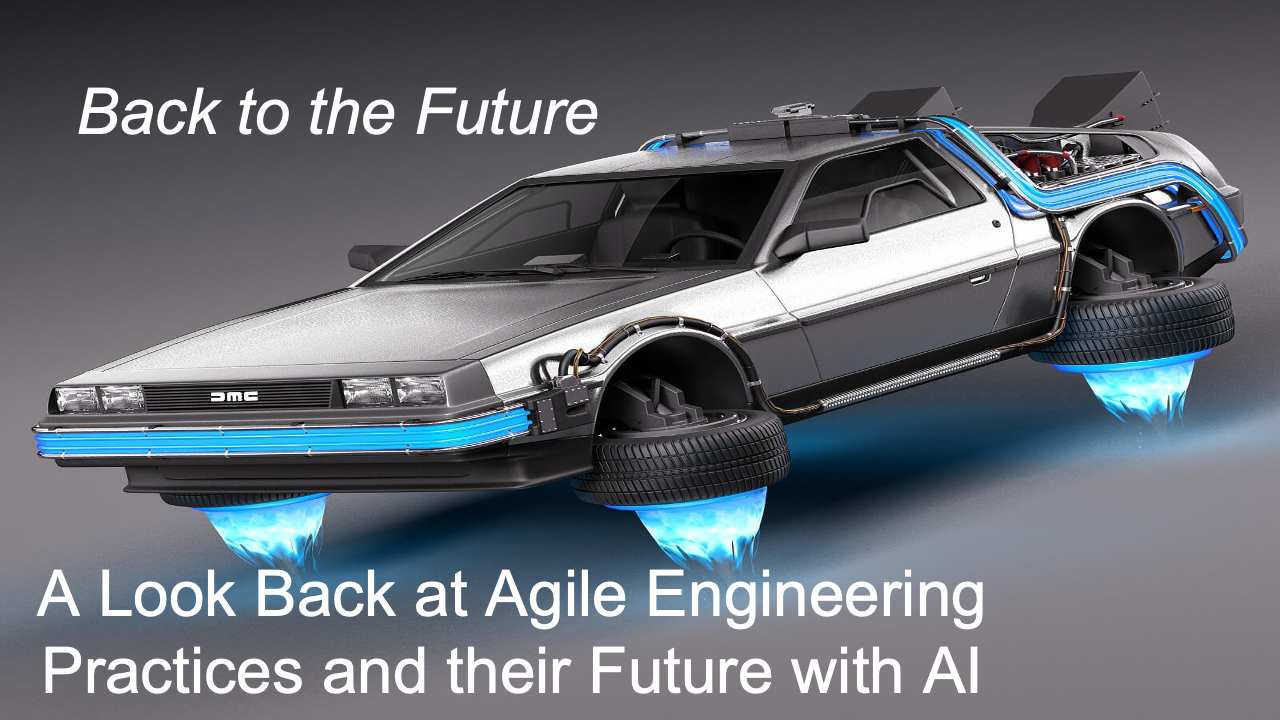
I want to thank Fadi for co-presenting and for the hard work he put in to our discussing, debating, and deliberating on the topic of Agile Engineering with AI. Our work together continues to shape my thinking on software development. I will have a follow-on blog post that covers our presentation in depth.
If you are interested in learning about AI TDD, or building quality products with AI, or other advanced topics, then I recommend you check out the Kaizenko offerings:
I highly recommend Fadi’s coaching and training. It’s top shelf. It’s practical, hands-on, and it’s the best place to start to elevate your know-how and get to the next level.
Check out all that Fadi does here: https://www.kaizenko.com/
These days I’m doing a lot of Coding with AI, which you can see on my YouTube channel, @stephenritchie4462. You’ll find various playlists of interest. For the Coding with AI playlist, I basically record myself performing an AI-assisted development task. I try ideas out in a variety ways, as a way to explore. If you are an AI skeptic, I recommend experimenting just to see how being an AI Explorer feels. I was surprised by how interesting and useful and fun coding with AI can be.
First, I attended the keynote speech by Zuzana “Zuzi” Šochová on “Organizational Guide to Business Agility”. I enjoyed many of the ideas that Zuzi brought out:
Note that AgileDC is on her Top 10 Agile conferences to attend in 2025.
Then I attended the Sponsor Panel discussion on The State of Agile in the DC Region. A lot of thought provoking discussion with both a somber yet hopeful tone. The DC region is certainly undergoing changes and managing the transition will be hard.
For Session 1, I attended Industrial Driven Development (IDD) by Jim Damato and Pete Oliver-Krueger. For me industrialization is a fascinating topic. It’s about building the machine that builds the machine. In other words, manufacturing a part or product in the physical world requires engineers to build a system of machines that build the part or product. I am amazed at what their consulting work has accomplished with regard to shortening lead times.
Next, I attended Delivering value with Impact by Andrew Long. This was the most thought provoking session of the day. I particularly liked the useful metaphors on connecting Action to Customer to Behavior to Impact. There were several key insight related to using customer behavior change as a leverage point to increase the business impact your receive from your team’s actions.
After a hardy lunch and catching up with Sean George, I attended the Middle guard in Midgard… session by David Fogel. The topic is related to how the Old Guard (fixed mindset) and the New Guard (growth mindset) represent two different camps found in the Agile transformation. Midguard is the present reality. So, as an Agile Coach you’re in the present reality of working with the Middle Guard, who are a mix of both fixed mindset reservations and growth mindset desires. After the topic was introduced, it was facilitated using “Pass the cards” per Jean Tabaka (or the 35 Shuffle technique), which was a masterclass in how to use dot voting efficiently in a workshop. A lot of good knowledge sharing.
Next, I attended AI Pair Programming: Human-Centered Development in the Age of Vibe Coding by George Lively. From my software engineering perspective, what I learned here will provide the most grist for my follow-on learning and experimentation. What George showed us was his excellent experiment and the demonstration of how AI-assisted software development can both accelerate delivery and be well managed. He applied static code analysis, test code coverage, quality metrics, and DORA metrics in a way that shows how AI Pair Programming can work well.
Next was Fadi and I at the 3:15pm session. As I mentioned above, I will blog separately on our session topic.
Finally, I sat in on Richard Cheng‘s From Painful to Powerful: Sprint Planning & Sprint Review That Actually Work session. Richard has an excellent way of explaining the practical application of the Scrum Framework. He takes the concepts and framework and gives clear advice on how to improve the events, such as Sprint Planning and Sprint Review. In this session, he reminded me of some of the pitfalls that trip me up to this day; I need to stop forgetting how to avoid them. The session showcased why Richard is an excellent Certified Scrum Trainer (CST), and his training never disappoints. Check out his offerings: https://www.agilityprimesolutions.com/training
As many of you might know, Richard and I used to co-train (though I was never on an equal footing) when we both worked together at the training org that is now Sprightbulb Learning.
In addition to attending sessions and learning a lot, it was great to catch up with friends and former colleagues who attended the conference. Some I hadn’t seen in years. A big highlight of AgileDC are the connections and reconnections in the DC area’s Agile community.
You’ll find Fadi on LinkedIn here: https://www.linkedin.com/in/fadistephan/
You’ll find my LinkedIn here: https://www.linkedin.com/in/sritchie/
Take care, please stay in touch, and I hope to see you next time!
A big thank you to the DC .NET Users Group for hosting my presentation on Continuous Integration at their Februrary meeting last night. I really hope that everyone enjoyed the presentation on continuous integration. The questions and conversations were very good.
Although most of the examples used TeamCity, here are the code samples, available through GitHub.
https://github.com/ruthlesshelp/Presentations
Here are the slides, available through SlideShare.
In November I traveled to Upstate New York to present at four .NET Users Group. Here’s the overview:
I realize it is belated, but I’d like to extend a very big and heartfelt thank you to the organizers of these users groups for putting together a great series of meetings.
Thank you to Stephanie Carino from Apress for connecting me with the organizers. I really appreciate all the help with all the public relations, the swag, the promotion codes, the raffle copies of my book, and for the tweets and re-tweets.
My presentations are available on SlideShare under my RuthlessHelp account, but if you are looking for something specific then here are the four presentations:
All the code samples can be found on GitHub under my RuthlessHelp account: https://github.com/ruthlesshelp/Presentations
If you attended one of these presentations, please rate me at SpeakerRate:
You can also rate me at INETA: http://ineta.org/Speakers/SearchCommunitySpeakers.aspx?SpeakerId=b7b92f6b-ac28-413f-9baf-9764ff95be79

Yesterday I traveled up to Long Island, New York to present at the LI .NET Users Group. A very big thank you to the LI.NET organizers for putting together a great September meeting. I especially enjoyed the New York pizza. The group last night was great. Very good turnout. The audience had many good questions and comments. Also, there were a lot of follow up discussions after the meeting.
Thank you to Stephanie Carino from Apress for connecting me with the organizers of LI.NET. I really appreciate all the help with all the public relations, the swag, the promotion codes, the raffle copies of my book, and for the live tweets and pictures.
I especially want to thank Mike Shaw for coordinating with me and recording the presentation. He was very helpful and kept me informed every step of the way. I will link to the presentation once it is posted.
Here are the code samples, available through GitHub.
https://github.com/ruthlesshelp/Presentations
Here are the slides, available through SlideShare.
 Although I have been developing software for more than 20 years, on Saturday I went to my first Code Camp. I delivered one session at Philly.NET Code Camp on the topic of Automated Unit and Integration Testing with Databases.
I was amazed. Philly.NET Code Camp is like a mini TechEd. I am impressed at how professionally everything was done. Registration, content, food, facilities, etc. This group knows how to put on a code camp. It is a testament to the capability and dedication of Philly.NET; it’s leadership and members. Keep up the good work. Thank you for an awesome day. I cannot wait for the next one.
Here are the slides, available through SlideShare.
The sample code from my session (Tools track, 1:40 PM) is available here:
Also, please review the requirements for using the code samples in the section below the slides.
To use the sample code, you need to create the Lender.Slos database. The following are the expectations and requirements needed to create the database.
The sample code assumes you have Microsoft SQL Server Express 2008 R2 installed on your development machine. The server name used throughout is (local)\SQLExpress. Although the sample code will probably work on other/earlier versions of SQL Server, that has not been verified. Also, if you use another server instance then you will need to change the server name in all the connection strings.
Under the 0_Database folder there are database scripts, which are used to create the database schema. For the sake of simplicity there are a few command files that use MSBuild to run the database scripts, automate the build, and automate running the tests. These batch files assume you defined the following environment variables:
The DbCreate.SqlExpress.Lender.Slos.bat command file creates the database on the (local)\SQLExpress server.
With the database created and the environment variables set, run the Lender.Slos.CreateScripts.bat command file to execute all the SQL create scripts in the correct order. If you prefer to run the scripts manually then you will find them in the $_Database\Scripts\Create folder. The script_run_order.txt file lists the proper order to run the scripts. If all the scripts run properly there will be three tables (Individual, Student and Application) and twelve stored procedures (a set of four CRUD stored procedures for each of the tables) in the database.
Pro .NET Best Practices
 Ruthlessly Helpful