Top Posts & Pages
Recent Posts
My Book
Pro .NET Best Practices
Stephen Ritchie's offerings of ruthlessly helpful software engineering practices.
John McBride recently wrote “Gas Town is a glimpse into the future”, and that article got me thinking about where we actually are on the road to AI-assisted software engineering. Not where enthusiasts claim we are. Not where skeptics fear we are. Where we actually are.
Gas Town is Steve Yegge’s experimental framework for agentic AI development. Instead of Sprints, Product Owners, and Scrum Masters, you’ve got towns, Mayors, rigs, crew members, hooks, and polecats. There’s only one human role: “a god-like entity called the Observer (you) who hands the mayor mandates.” The system runs continuous agent sessions, it’s highly experimental, and—at the moment—only works for people who can afford dozens of Claude Max accounts at $200/month each.
It’s also described as addictive.
I’m not recommending you install Gas Town. I’m not installing it myself. But watching what explorers like Yegge are doing tells us something important about where this technology actually is; and how long it might take before the rest of us can use it productively.
The Oregon Trail to Agentic AI
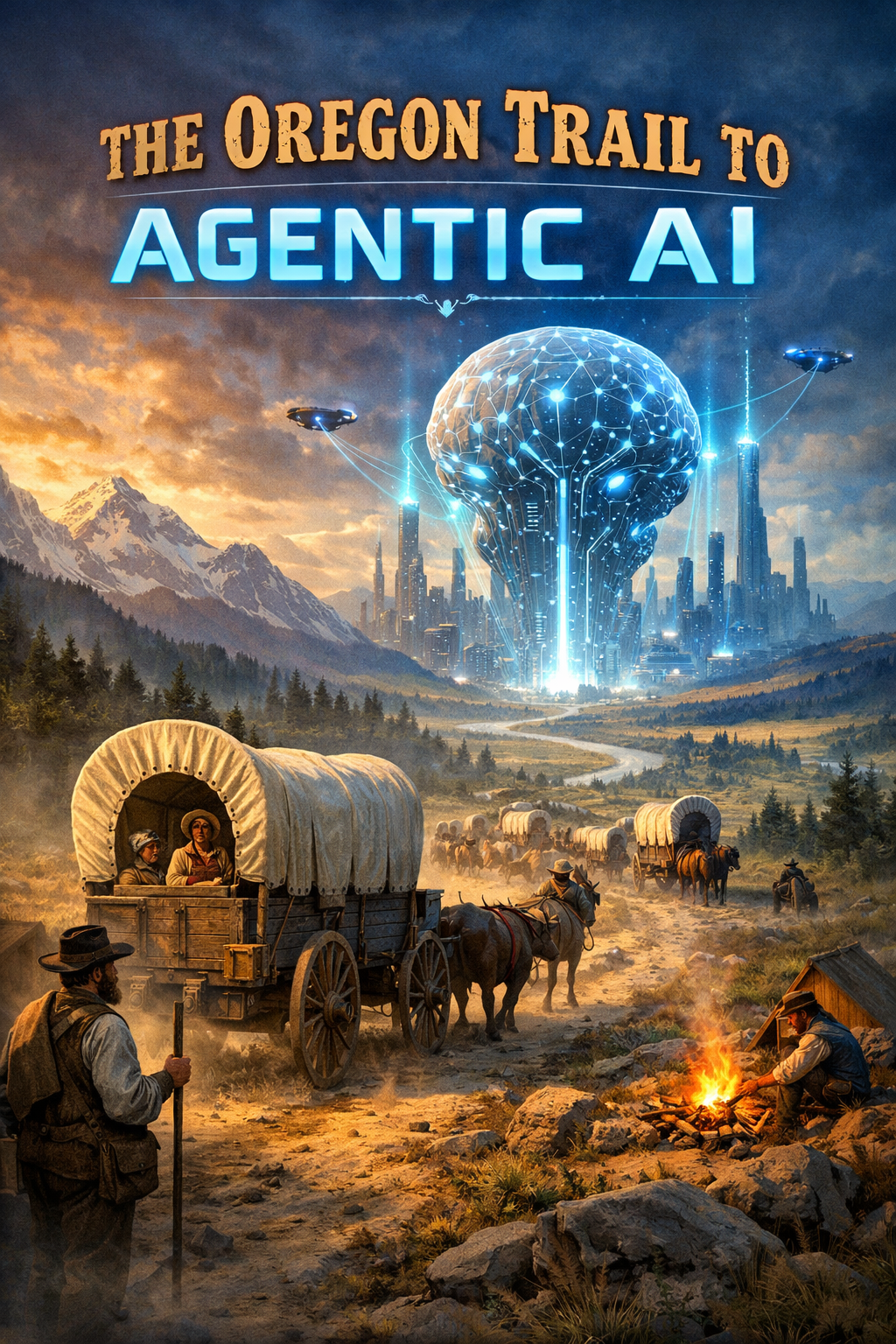
I often use a metaphor of change by reflecting on the journey from St. Louis to Oregon:
The journey that once required years of preparation and carried a significant chance of death is now a routine afternoon trip. But it didn’t happen overnight. Each stage required different capabilities, different costs, and different levels of acceptable risk.
From what I can tell, Gas Town is firmly in the Lewis and Clark phase of discovery.
Steve Yegge isn’t building a product. He’s running an expedition. In interviews, he says he’s pushing limits and expects that someone will eventually put this together in a way that people can reason about easily. With that new tooling, process, and practices, there will be new roles, events, and artifacts.
This is exactly what explorers do: they chart unknown territory so that later travelers can understand the terrain.
The terrain Yegge is mapping includes questions like:
These are the questions that must be answered before we can build the Oregon Trail, let alone the railroad.
Let me apply the framework from my book to evaluate where agentic AI development actually stands today:
Verdict: No, not yet—for most teams
Gas Town requires: – Dozens of concurrent AI sessions ($200/month each) – Tolerance for experimental, addictive tooling – Significant expertise to interpret and correct agent behavior – A willingness to be an explorer, not a traveler
This isn’t a criticism. Lewis and Clark’s expedition wasn’t practicable for Oregon farmers either. That was never the point. The expedition’s purpose was discovery, not travel.
For typical development teams, the current state of agentic AI is: – Too expensive for routine use – Too unpredictable for production work – Too complex for teams without dedicated expertise – Too immature for sustainable practices
Verdict: No. It’s an explorer community, not general adoption
There’s no industry data on agentic AI adoption because there’s nothing widespread enough to measure. The community consists of: – AI researchers and enthusiasts pushing boundaries – Well-funded experiments at large technology companies – Individual explorers like Yegge with the resources and appetite for risk
This is normal for the Lewis and Clark phase. The practice isn’t generally accepted because it isn’t general yet.
Verdict: The potential is enormous, but current value is unclear
The promise of agentic AI is compelling: – Dramatically reduced development time for routine work – Ability to tackle larger projects with smaller teams – Automation of tedious maintenance and refactoring tasks
But the current reality is: – High cost-to-benefit ratio for most use cases – Significant time spent supervising and correcting agent behavior – Quality concerns about AI-generated code at scale – Unknown long-term maintenance implications
We don’t yet know whether the value proposition will hold up as the technology matures, or whether the costs will decrease faster than the capabilities improve.
Verdict: Not for production use; it’s only for experimentation
Gas Town itself is an example, but it’s explicitly experimental. Yegge describes it as “addictive” and acknowledges it’s not ready for general use. There are no archetypal patterns yet for: – Integrating agentic AI into typical development workflows – Managing the costs at sustainable levels – Ensuring quality and maintainability of agent-produced code – Training and onboarding teams to work with these systems
Overall Assessment: 0/4 criteria met for production adoption
This doesn’t mean agentic AI won’t eventually meet all four criteria. It means we’re watching an expedition, not a product launch.
An article in Today in Tabs, “All Gas Town, No Brakes Town,” asks exactly the right questions:
“Will the AI ever gain a high level conceptual understanding of how to structure software to be reliable and maintainable, when it isn’t currently capable of a high-level conceptual understanding of how to run a vending machine? Will today’s junior developers ever gain that understanding themselves if they spend their careers instructing the AI rather than writing code? Will there even be junior developers if all the senior devs are handing off that work to polecats or whatever?”
These aren’t questions that explorers need to answer. Lewis and Clark didn’t need to figure out how to run a railroad or schedule commercial airline flights. But these are the questions that matter for the Oregon Trail and beyond.
If junior developers spend their early careers instructing AI rather than writing code, will they develop the deep understanding needed to: – Debug complex systems? – Make architectural decisions? – Identify subtle quality problems? – Know when the AI is wrong?
We don’t know the answer. The pioneers who eventually walked the Oregon Trail developed practical skills that railroad passengers never needed—and those skills became obsolete. Perhaps the same will happen with traditional coding skills. Perhaps it won’t.
Current AI systems are impressive at pattern matching and code generation, but they lack the conceptual understanding that experienced developers bring. They can produce code that looks right but isn’t—because they don’t understand what “right” means in context.
Will that change? Maybe. The gap between GPT-3 and GPT-4 was surprisingly large. Future advances might bridge the conceptual gap. Or the gap might prove fundamental.
Right now, agentic AI is expensive. Dozens of sessions at $200/month adds up quickly. For the economics to work broadly, either: – AI compute costs must drop dramatically – AI productivity gains must exceed the high costs – New architectures must emerge that are more efficient
All three are plausible. None is guaranteed.
The history of the Oregon Trail suggests some patterns:
Before there’s a railroad, there will be trails. Expect: – Frameworks and tools that make agentic AI more accessible – Best practices emerging from early adopters – Significant failures and hard lessons – Gradually decreasing costs and increasing capabilities – Enterprise experiments with mixed results
This phase will be characterized by high effort, high risk, and high reward for those who get it right. Most organizations should observe carefully but not invest heavily.
Eventually, the paths will be well-worn enough to build reliable infrastructure. Expect: – Platform products that abstract away complexity – Standardized practices for human-AI collaboration – Predictable cost and quality models – Mainstream adoption by large enterprises – Significant workforce transformation
This is when most organizations should adopt—when the practices become practicable, generally accepted, valuable, and archetypal.
At some point, the journey becomes routine. Expect: – AI-assisted development as a standard capability – Developers who never knew a world without AI agents – New challenges we can’t currently anticipate – Integration so deep it’s invisible
But remember: the people flying Southwest today don’t need to know anything about Lewis and Clark. The knowledge and practices evolved until the complexity was hidden.
If you’re a development leader, the question isn’t “should we adopt agentic AI?” The question is: “What phase of the journey are we prepared for?”
Commentary: When I wrote “Pro .NET Best Practices” in 2011, I didn’t dare imagine the AI developments we’re seeing today. But the framework I developed (practicable, generally accepted, valuable, and archetypal) applies directly to evaluating emerging technologies. The question is never “is this exciting?” It’s always “is this right for our team, right now?” For most teams, agentic AI isn’t right yet. That’s not a criticism of the technology. It’s a recognition of where we are on the trail.
Even if you’re not ready to join the expedition, the explorers are generating valuable knowledge:
Gas Town is genuinely fascinating. Steve Yegge and explorers like him are doing important work that will eventually benefit all of us. They’re finding the paths, documenting the obstacles, and demonstrating what’s possible.
But the Oregon Trail killed a lot of pioneers. The people who prospered were the ones who waited for the railroad (or fly Southwest).
For most development teams, the ruthlessly helpful approach to agentic AI is:
The journey from St. Louis to Oregon is now a $170 flight. Someday, AI-assisted software development will be that routine. But we’re not there yet.
We’re watching Lewis and Clark from a distance, taking notes, and preparing for the world they’re discovering.
Pro .NET Best Practices
 Ruthlessly Helpful
I appreciate how grounded this is. Framing agentic AI as an exploration phase rather than a ready-made destination feels honest and useful. The Oregon Trail metaphor works because it resists both hype and fear. Watching the explorers, learning from their failures, and not mistaking experimentation for maturity seems like the most rational posture right now.