Top Posts & Pages
Recent Posts
My Book
Pro .NET Best Practices
Stephen Ritchie's offerings of ruthlessly helpful software engineering practices.
A very big thank you to AgileDC 2025 for hosting our presentation yesterday. Fadi Stephan and I gave a talk titled, “Back to the Future – A look back at Agile Engineering Practices and their Future with AI” offered our experience and perspective on a few important questions:
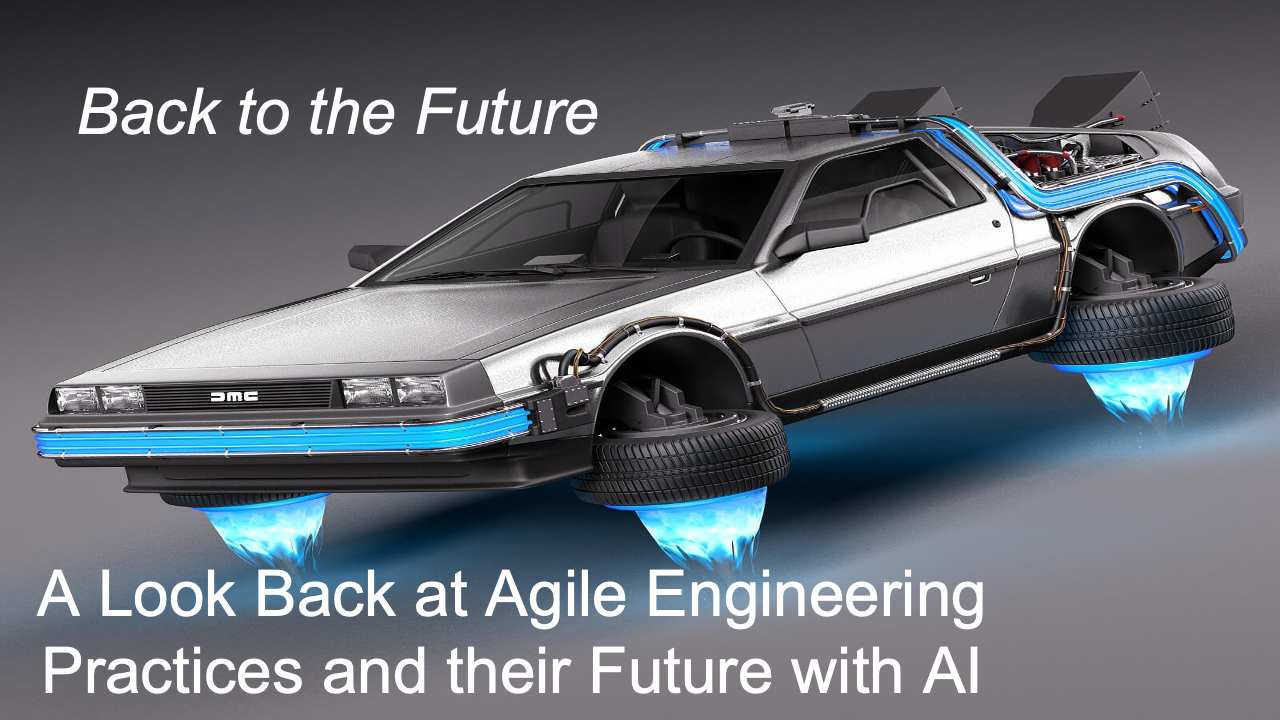
I want to thank Fadi for co-presenting and for the hard work he put in to our discussing, debating, and deliberating on the topic of Agile Engineering with AI. Our work together continues to shape my thinking on software development. I will have a follow-on blog post that covers our presentation in depth.
If you are interested in learning about AI TDD, or building quality products with AI, or other advanced topics, then I recommend you check out the Kaizenko offerings:
I highly recommend Fadi’s coaching and training. It’s top shelf. It’s practical, hands-on, and it’s the best place to start to elevate your know-how and get to the next level.
Check out all that Fadi does here: https://www.kaizenko.com/
These days I’m doing a lot of Coding with AI, which you can see on my YouTube channel, @stephenritchie4462. You’ll find various playlists of interest. For the Coding with AI playlist, I basically record myself performing an AI-assisted development task. I try ideas out in a variety ways, as a way to explore. If you are an AI skeptic, I recommend experimenting just to see how being an AI Explorer feels. I was surprised by how interesting and useful and fun coding with AI can be.
First, I attended the keynote speech by Zuzana “Zuzi” Šochová on “Organizational Guide to Business Agility”. I enjoyed many of the ideas that Zuzi brought out:
Note that AgileDC is on her Top 10 Agile conferences to attend in 2025.
Then I attended the Sponsor Panel discussion on The State of Agile in the DC Region. A lot of thought provoking discussion with both a somber yet hopeful tone. The DC region is certainly undergoing changes and managing the transition will be hard.
For Session 1, I attended Industrial Driven Development (IDD) by Jim Damato and Pete Oliver-Krueger. For me industrialization is a fascinating topic. It’s about building the machine that builds the machine. In other words, manufacturing a part or product in the physical world requires engineers to build a system of machines that build the part or product. I am amazed at what their consulting work has accomplished with regard to shortening lead times.
Next, I attended Delivering value with Impact by Andrew Long. This was the most thought provoking session of the day. I particularly liked the useful metaphors on connecting Action to Customer to Behavior to Impact. There were several key insight related to using customer behavior change as a leverage point to increase the business impact your receive from your team’s actions.
After a hardy lunch and catching up with Sean George, I attended the Middle guard in Midgard… session by David Fogel. The topic is related to how the Old Guard (fixed mindset) and the New Guard (growth mindset) represent two different camps found in the Agile transformation. Midguard is the present reality. So, as an Agile Coach you’re in the present reality of working with the Middle Guard, who are a mix of both fixed mindset reservations and growth mindset desires. After the topic was introduced, it was facilitated using “Pass the cards” per Jean Tabaka (or the 35 Shuffle technique), which was a masterclass in how to use dot voting efficiently in a workshop. A lot of good knowledge sharing.
Next, I attended AI Pair Programming: Human-Centered Development in the Age of Vibe Coding by George Lively. From my software engineering perspective, what I learned here will provide the most grist for my follow-on learning and experimentation. What George showed us was his excellent experiment and the demonstration of how AI-assisted software development can both accelerate delivery and be well managed. He applied static code analysis, test code coverage, quality metrics, and DORA metrics in a way that shows how AI Pair Programming can work well.
Next was Fadi and I at the 3:15pm session. As I mentioned above, I will blog separately on our session topic.
Finally, I sat in on Richard Cheng‘s From Painful to Powerful: Sprint Planning & Sprint Review That Actually Work session. Richard has an excellent way of explaining the practical application of the Scrum Framework. He takes the concepts and framework and gives clear advice on how to improve the events, such as Sprint Planning and Sprint Review. In this session, he reminded me of some of the pitfalls that trip me up to this day; I need to stop forgetting how to avoid them. The session showcased why Richard is an excellent Certified Scrum Trainer (CST), and his training never disappoints. Check out his offerings: https://www.agilityprimesolutions.com/training
As many of you might know, Richard and I used to co-train (though I was never on an equal footing) when we both worked together at the training org that is now Sprightbulb Learning.
In addition to attending sessions and learning a lot, it was great to catch up with friends and former colleagues who attended the conference. Some I hadn’t seen in years. A big highlight of AgileDC are the connections and reconnections in the DC area’s Agile community.
You’ll find Fadi on LinkedIn here: https://www.linkedin.com/in/fadistephan/
You’ll find my LinkedIn here: https://www.linkedin.com/in/sritchie/
Take care, please stay in touch, and I hope to see you next time!
In Mark Winteringham’s latest book, “AI-Assisted Testing,” he offers a balanced guide to the future of software testing. Manning early access version: https://www.manning.com/books/ai-assisted-testing

The field of software testing is rapidly evolving, and the author conducts a thoughtful and practical exploration of how artificial intelligence (AI), particularly generative AI, can improve the testing landscape.
Mark Winteringham’s journey into software testing is somewhat unconventional. Initially, he aspired to be a musician. He made his way into software testing through an interest in computers and his job testing music software. His background gave him a unique approach to testing, with a creative problem-solving aspect. The author’s 15+ years of experience and his previous book, “Testing Web APIs,” establishes him as a good thought leader in testing. I enjoyed learning more about Mark Winteringham during this HockeyStick Show interview.
What I like about “AI-Assisted Testing” is that it’s a structured guide through the many ways AI can enhance software testing. The book is divided into three main parts:
This section introduces the concept of large language models (LLMs) and how they can be leveraged to enhance testing activities. Winteringham emphasizes the importance of understanding the potential and, what’s more important, the limitations of these models. He advocates for a balanced approach that integrates human expertise with AI capabilities.
Instead of attempting to use LLMs to replicate the full gamut of testing activities that exist within a lifecycle, we prioritize the best of our abilities as humans and the value we bring to testing. Then we choose to add LLMs in select areas to expand our work so that we can move faster, learn more and help ensure our teams are better informed so that they can build higher-quality products.
Here, Winteringham dives into practical applications of LLMs in various testing scenarios. From test planning and data generation to UI automation and exploratory testing, the book provides concrete examples and use cases that demonstrate the tangible benefits of AI-assisted testing.
The final section explores advanced topics such as fine-tuning LLMs with domain-specific knowledge and using retrieval-augmented generation (RAG) to improve testing outcomes. This part is particularly useful for testers looking to tailor AI tools to their specific needs.
One of the things I like about “AI-Assisted Testing” is its practical focus. Winteringham does not merely theorize about the potential of AI; he provides detailed inputs and examples of how to implement AI tools in real-world testing scenarios. For instance, he explains how to use AI to generate boilerplate code for test automation, thus saving valuable time and allowing testers to focus on more complex tasks.
He also highlights the importance of prompt engineering – the art of crafting effective inputs for AI models to maximize their output. He provides readers with a library of prompts and practical tips for creating their own, ensuring that testers can harness the full power of AI without falling into common pitfalls.
Throughout the book, Winteringham maintains a healthy skepticism about the capabilities of AI, cautioning readers against over-reliance on these tools. He emphasizes that AI should be seen as a “collaborator” rather than a replacement for human testers. This perspective is really important in our industry, which often swept up in the hype of new technologies.
In his interview, Winteringham elaborates on this point, noting that while AI can significantly enhance certain aspects of testing, it cannot replicate the critical- and lateral-thinking skills of a human tester. He argues that the real value of AI lies in its ability to handle repetitive, algorithmic tasks, freeing up testers to engage in more creative and analytical work.
Winteringham’s emphasis on the human element in testing is a recurring theme in both the book and his interview. He advocates for a collaborative approach where testers use AI tools to augment their skills and improve their efficiency. This perspective is refreshing in an era where the fear of job displacement by AI is prevalent.
By highlighting the need for empathy, collaboration, and critical thinking in testing, Winteringham ensures that “AI-Assisted Testing” is not just about technology but also about the people who use it. His approach encourages testers to view AI as an ally that can help them achieve better results, rather than a threat to their livelihood.
I think that “AI-Assisted Testing” is a must-read for anyone involved in software testing. It offers a comprehensive and balanced view of how AI can be integrated into testing processes. It provides practical insights and examples. It makes theoretical concepts accessible and actionable.
Pro .NET Best Practices
 Ruthlessly Helpful