Top Posts & Pages
Recent Posts
My Book

Pro .NET Best Practices
Stephen Ritchie's offerings of ruthlessly helpful software engineering practices.
Fadi Stephan and I presented our Back to the Future – A look back at Agile Engineering Practices and their Future with AI talk at AgileDC 2025. I think Back to the Future with AI is bit simpler.
In this blog post I explain what this talk is all about. The theme is to understand how AI is transforming the Agile engineering practices established decades ago.
The talk began by revisiting the origins of Agile in 2001 at Snowbird, Utah, when methodologies like XP, Scrum, and Crystal led to the Agile Manifesto and its 12 principles. We focused on Principle #9 “Continuous attention to technical excellence and good design enhances agility” and asked whether that principle still holds true in 2025.
Note: AI isn’t just changing how code is written … it’s challenging the very reasons Agile engineering practices were created. Yet our goal is not to replace Agile, but to evolve it for the AI era.
We reviewed six practices that we teach and coach teams on as we reflect on the adoption.
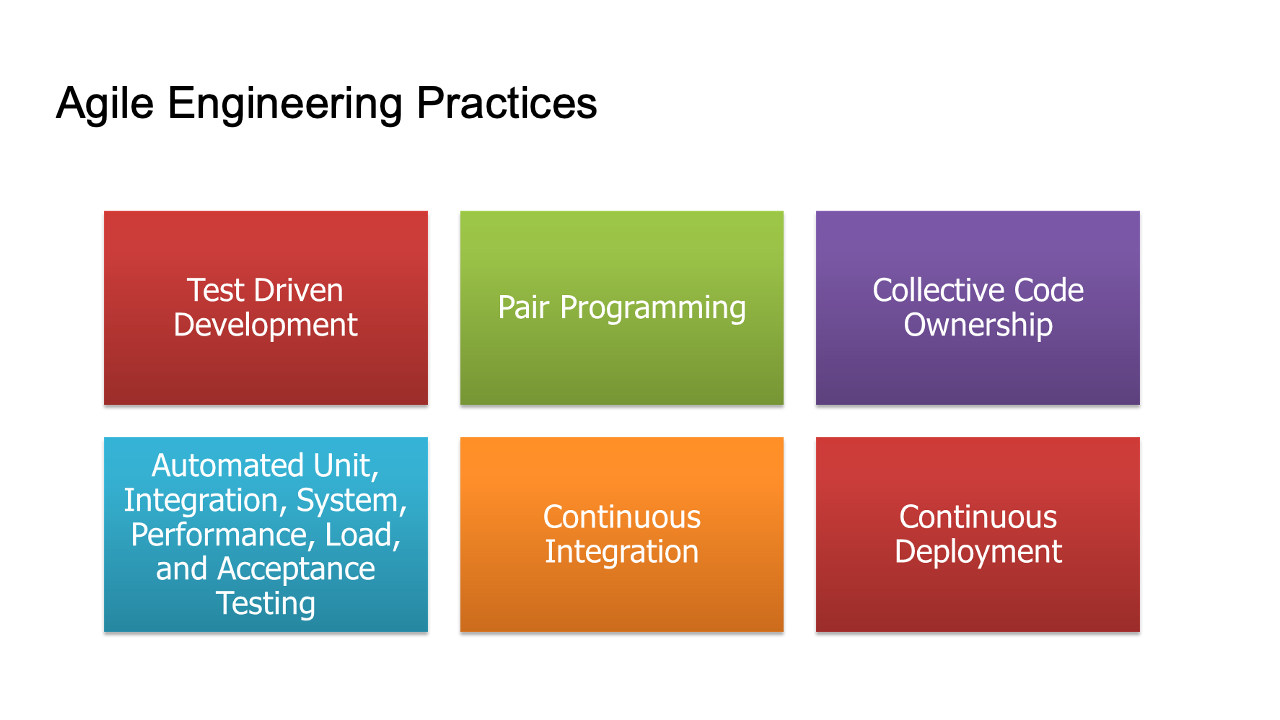
Note: that while CI/CD and test automation have spread widely, it is true TDD, Pair Programming, and Collective Code Ownership that remain rare. Yet these are the very practices that make the others sustainable.
Part 1: Fadi and I performed human-with-human TDD and pair programming using a simple spreadsheet project.
Part 2: I continued the process with AI assistance (GitHub Copilot), showing how AI can take over much of the “red-green-refactor” loop through comment-based prompting.
Next, we looked toward the future and made some informed guesses about where things might go.
| Classic Agile Practice | Evolved AI Practice |
|---|---|
| Test-Driven Development | Prompt-Driven Development |
| Pair Programming | AI Pairing |
| Collective Code Ownership | AI Code Ownership |
| Automated Testing | Acceptance Spec–Driven Development |
| Continuous Integration | AI-Generated Test Suites |
| Continuous Deployment | Infrastructure as Spec |
As AI takes over mechanical and repetitive aspects, the human role shifts to:
We concluded the talk by emphasizing that Agile’s core values of collaboration, learning, and delivering customer value will remain essential. However, the means of achieving technical excellence are evolving rapidly. Rather than resisting change, developers should co-evolve with AI, embracing new forms of collaboration, feedback, and craftsmanship.
The Agile practices of 2001 are not obsolete; but in the age of AI, they are being reborn.
Pro .NET Best Practices
 Ruthlessly Helpful
This is Fadi Stephan’s blog post on the Agile Engineering practices with AI. This was the basis for our AgileDC talk.
https://www.kaizenko.com/agile-engineering-practices-in-the-age-of-ai-what-still-matters-in-2025/